No products in the cart.
Five Signs a Conveyor Transfer Point Is Costing You
When a production line slows down, the machines usually get the blame. The filler, the labeller, the packer. But very often the real problem sits in the gap between them: the point where product moves from one conveyor to the next.
Transfer points are easy to overlook because they rarely stop a line outright. They just take a little time, a little product and a little attention, every shift. Here are five signs one of yours is costing you, and what to check before your busy season.
1. Product tips, twists or falls over
If product changes orientation as it crosses from one conveyor to another, the handover isn’t smooth. Common causes are a height difference between the two conveyors, a gap that’s too wide for the product’s footprint, or a sudden change in speed.
Tall, narrow or light products are the most sensitive. Bottles, cans and lids will show you a transfer problem long before a carton will.
2. Someone is standing there “helping”
If a team member spends part of their shift nudging product across a gap, straightening it or clearing small jams, that transfer point has quietly become a job. It’s worth asking how many hours a week that adds up to, and whether that person would be more useful somewhere else.
3. Product arrives in gaps, then bunches
A run of product, then a gap, then a pile-up usually means the conveyors either side of a transfer aren’t matched. The downstream conveyor may be running slower than the one feeding it, or product is being held and released unevenly.
Speed matching, or a short accumulation section, can smooth the flow so the next machine gets a steady feed.
4. Scuffs, dents or marks on finished product
Damage that appears at the same place on every product is a clue. Look at side guides, the edges of transfer plates and any corners where product changes direction. A guide set too tight, a worn edge or a sharp change of direction can mark product that’s otherwise been handled well all the way down the line.
5. An upstream machine stops because the next stage can’t keep up
This is the costly one. If a filler or processing machine has to stop because packers or the next machine can’t keep pace, the line is only as fast as its slowest point, and there’s nowhere for product to wait.
Accumulation space gives the line a buffer. At Resene, for example, packers couldn’t keep up with a new paint can filler and a small rotary table held less than 30 seconds of production. EQM designed an end-of-line system that holds more than five minutes of cans and feeds them back automatically once packers catch up. Read the Resene case study.
What to check before your busy season
You don’t need a full line review to find a problem transfer point. Start with these:
- Film each transfer point on your phone for a minute at full production speed. Problems that are easy to miss in person are obvious on replay.
- Check conveyor heights and gaps either side of each transfer.
- Note the speed of each conveyor, and whether product speeds up or slows down at the handover.
- Look for wear on guides, transfer plates and bends.
- Ask the people on the line which spots they have to keep an eye on.
Small changes, or a new layout
Many transfer problems can be fixed with an adjustment, a new guide, a transfer plate or a speed change. Others point to a layout that no longer suits the product or the volume.
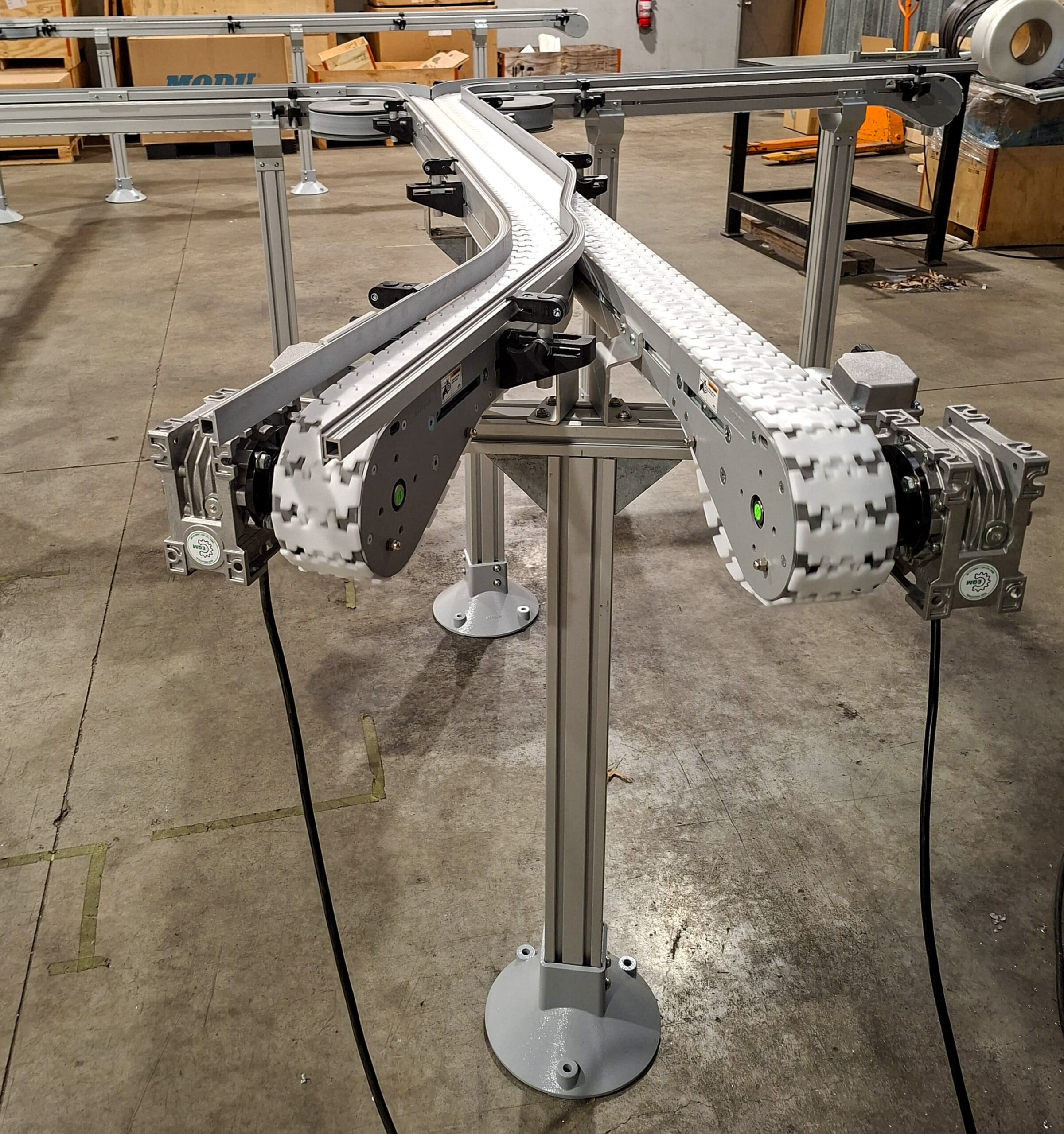
Modular conveyor systems like MODU make both easier. In one recent project, EQM used MODU MM3 chain conveyor to bring plastic lids from two injection moulding machines into one controlled flow, with low side guides to keep the lids stable. The system was assembled and tested in our workshop before it went to site. See the lid conveyor project.
Send us a short video
If there’s a transfer point on your line you’d like a second opinion on, send us a short video, the product size and weight, and the speeds you’re running. Email [email protected] and the team will take a look.
Eliminating bottlenecks. Boosting productivity in every industry.
Drive motors and conveyor systems that work.
0800 147 847 | [email protected] | eqm.co.nz